2.25.2011

My Decidedly UnSexy Makeup for the Monologues

The good news: I'm on the cover of the Emory Wheel! I'm the one in red and black, onstage.

The Emory Wheel 2/21

This is how it looked up close:

In the bathroom, putting on ageifying makeup with Angelle Tanner.
Yeeeeaaaah. Oo, sexy.

I'm front and center with a large part of the cast. Aren't they lovely?
The bad news: I was on the cover of the Emory Wheel... looking like that.

But it's OK. It would have been a whole other story if I had been trying to look cute, but sure enough, my wearing the "mask" of being someone else gave me the leeway not to care about how "beautiful" Lauren looked.

I spend a lot of my time, day to day, talking about "the problem." Sometimes it's heresy (that's in Christian History class) or divine wrath (in Old Testament class); other times, it's homelessness, or homophobia, or lack of funding to pay social workers, teachers and cops a decent salary and what that says about our values as a country. I think about the issues associated with the market economy (in Markets, Justice and Christian Ethics class) or with the impossibility of personal actualization in a system which keeps us from defining ourselves independent of what the advertising industry inundates us with (in Morality in American Life). I consider steps towards solving problems that are part of modern life, so ingrained in our collective souls that we don't even see them until we're in pain. For example, I didn't think about just how much I relied on my youth and "beauty" to define myself until I perceived myself losing it.

As you might expect, I also spend a lot of time fighting the hopeless feeling that the problems are too huge, and I am too small and powerless, to ever solve or even ameliorate them. No one listens to some grad student living in Atlanta with no money or powerful friends, and do I shape public policy? Pff. Please. I can't change "the problem." So what's the point?

I have little to no control over the world... but I have control over myself.

I have daily conversations about this with lots of women, and at least as many with men, and all of them, down to the last one, have been affected in some way by this project. No one hears about it and is totally bored-- at worst, they tilt their heads and go, "Huh. That's interesting." Women love to talk about what a pain in the ass it is to have to look cute all the time, or how they stopped caring through some life-changing event, or how they could never, ever, leave the house without foundation, and why that is. Men tell me how much more they like women who don't wear makeup (I mean, like, a lot of men), and how sexy it is when a woman walks around with nothing but confidence on her face. Some women have even begun to question their own habits, and one of two have joined me for a day or so at a time to see what it feels like. My choice to change has made other people think about their assumptions, and I can't tell you how gratefully I feel about that.

There's a huge, stupid, oppressive beauty standard and attendant industry in Western culture that insists that youth, long hair, white teeth, and a tiny waist are the ultimate goals in life, and I can't change what the masses think. But what I've done in TME has been like a billboard advertising an alternative way of moving through the world as a woman... and I can certainly see why many women, religious and otherwise, choose to do so.

2.17.2011

The Oppression of Sexual Violence

As you may have guessed by now, my interest in TME is really about awareness of oppression of women, in whatever form it comes. Tonight, I'll be onstage in an all-proceeds-go-to-charity event designed to raise awareness and money for the support of groups committed to the protection of women:

The Vagina Monologues at Emory

Contrary to popular belief, this show is not just a bunch of random women getting up and talking about their individual vaginas, nor is it a bunch of man-hating rhetoric or self-indulgent whining. It's the culmination of years of interviews, writing and work by Eve Ensler, who compiled this play in order to address the oppression of women as it appears in the guise of fear of the vagina. "Vagina," in this context, is analogous to a woman's sense of self, safety, and sexuality. In The Vagina Monologues the audience (and the actors, really) learn things they never knew while laughing hysterically, and in the cases of many women I've seen the show with, will be cheering at least once during the show. (Unless you have no soul.)

Fun+Learning+All Proceeds to Charity = YOU NEED TO BE THERE.

Trust me, you'll have a great time. Really. If you don't, you can comment on this blog and slam me until your fingers fall off.

2.12.2011

"How do you feel?"

Ahhhh. Sermon is done, and I survived this past week (more or less, if you don't count the short paper I totally spaced on). So now I have some more time to spend catching up on TME, and I can tell you how I really feel about all this.

This coming week, I have rehearsals every night for The Vagina Monologues. I'm performing, "The Flood," a story about an old lady (75-ish) who is so alienated by her first sexual experience that when it's over, she "closes the whole store." It's sad and funny, and because I'll be onstage I've had to consider whether or not to wear makeup-- stage makeup, of course. The purpose is to make my features visible, and in this case the point will be to make me look much older. This made the decision to wear makeup easier: I'm not trying to look beautiful. I'll be wearing a thick layer of foundation and contouring my cheeks so that they look saggier, and making my lips look smaller. Also, it won't be "me" onstage, it's not "Lauren." It's an old lady who's never told anyone about the most humiliating experience of her life-- so this will have nothing to do with my identity.

The Vagina Monologues on Creative Loafing!

Speaking of which, I would like to say for the record: this project has been one of the best things I've ever done for myself. When I had to preach my sermon on the 4th I wore makeup:

This picture is courtesy of Candler Theological Seminary. All rights reserved. In other words, don't re-use it, or get ready to receive a lot of letters from a troupe of lawyers.
You know what? I felt less beautiful with makeup on. Really. I looked in the mirror before the sermon and saw what was wrong with my face, how my blemishes weren't covered. I constantly worried about whether I was wearing enough lip color; I was back, in one fell swoop, to wondering what I didn't have as opposed to accepting what I did. The chapel is naturally lit with windows in the ceiling, and somehow, I felt self-conscious about peely skin and clumpy mascara showing up in the bright sunlight.

I think that I felt this way not because makeup makes me less beautiful, but because when I go natural I don't feel like I'm communicating that I want to look different than I already do. When I'm wearing makeup, in a way I'm inviting people to appraise my appearance. When I'm not, I feel like I'm saying, "This is how I look, and I'm cool with that." I move far more freely through the world because I'm not putting on a costume. I walk into coffee shops and no longer worry about what the strangers I'm walking past think, and when I walk into class in one of the larger rooms I no longer consider how to walk from the door up the stairs and to my seat in ways that give some overall impression of... something or other, an impression that, when all is said and done, I can't really control at all. I feel feminine, powerful, and beautiful.

Also, I can now say with absolute confidence that I have more mental space to devote to other things. I say "space" because that's what it feels like, as though I have more breathing room in my head. I'm not guilt-tripping myself over makeup that I bought that I didn't need, or looking at my hair and wondering if I should schedule an appointment to get a trim, and where (because a bad haircut, for me, is the end of the bloody world). I'm not looking at lipstick and convincing myself it'll make me beautiful finally. There's a sense of relief, like I've put down a weight that I had agreed to carry because I thought I had to. I put on clothes in the morning, don a headscarf, and go about my day, never to worry about my appearance again until the next morning, apart from tucking in my hair or adjusting a shirt. I still get lots of compliments on how I look.

I've heard a few really inspiring stories about women's transformative experiences: one woman told me about shaving her head in India. She described it as "a baptism." Another woman I know told me about the freedom of pregnancy, how you no longer care about what people think about your hair or whatever cause you're tired, dammit, and how that led her to let go of her attachment to her appearance. Packing for trips is ridiculously easy-- no more bringing along 47 makeup options, hair dryer, hair stuff, and brushes to tote around. Several people have told me that they didn't notice that I'm not wearing makeup any more-- they notice the headscarf, but that's it.

And so I say to you, my lovely ladies (and of course, the gentlemen who love happy women): I had once thought that beauty products were what made me beautiful. Now I know, without a doubt, that I don't need any of that crap, and I can't recommend highly enough that at some point, you try something like this. I know, it seems scary. Remember how terrified and miserable I was at the beginning of all this? I couldn't even conceive of a life where I didn't define a large part of myself by my appearance. Now, I just don't think about it much any more, and I'm a million times happier. I work out and take care of myself, but beyond that, you know what? I just don't need all the crap they're trying to sell me, and where before I was just saying that, I finally feel like it's true. Nail polish commercials, hair commercials, jeans, anti-aging treatments, eye shadow that supposedly makes your eyes look "more" blue or brown or green or hazel... it's endless, and it's just a bag of bricks I no longer want to carry around.

I do miss the fun parts-- getting made up is fun. But I feel a million times more secure because I know now that how I look is not nearly as big a deal as I thought it was.

People ask me if I'll "carry any part of the experiment with me," meaning, Will I wear as much makeup? What about my hair? My answer is, I'm actually trying to think of excuses to keep doing it after I turn 30. I don't ever want to go back to how I felt about myself before. My mind may change, but right now... it's just a relief.

2.08.2011

EXTREEEEME MODESTY!!

At the beginning of this month I decided to challenge myself a little more with respect to how I was dressing. See, I was wearing cute hats, shirts and pants, and while it was initially difficult it got to a point where I realized that I was dressing sort of the same as before, only now I only wore hats and long-sleeved shirts.

So I decided that, for the month of February (at least) I was going to try some headscarf action, and only wear skirts. The results have been really interesting.

1) I feel beautiful, and I get complimented a lot on how "elegant" or "classy" I look. I feel elegant.
2) At least five people who know me well did not recognize me with a headscarf on. This, according to several of them, is because I look like a Muslima, and they're not used to my looking like that. A few times, I've actually had to point to myself and say, "Lauren," when someone stares confusedly into my face when I greet them in the morning. Also contributing to this phenomenon, and more interesting because it's the opposite of what I expected:
3) NO ONE looks at me.

This last one is, according to those I have asked, because, "You try not to stare at people who are significantly different," especially Muslim women. We're taught, when we see a woman with a headscarf, not to stare at her to avoid making her uncomfortable. Makes sense, but it's the opposite of what I expected.

In general, I feel less trendy and less visible (although I'm sure people are staring at me when I'm not looking), but even more femininely beautiful.

Last Thursday I gave a sermon at Candler, and I wore makeup. I'll write more this week about how that felt-- it was truly shocking how much less-beautiful I felt, and how much more I worried about how I looked.

But for now, another brutal week in grad school is looming! If you'd like to hear the sermon (it was about immigration), go to "Sermons and Speeches on iTunes" in the center of this page:

Unitarian Universalist Student Service: Sermon

The name to look for is "Lauren Shields," down near the bottom.

Stay warm! (P.S. Headscarves are great for this...)

1.31.2011

Two items, one advertisement

I like to watch commercials and try to pick out what they say they're selling (which is "unnecessary in the hunter-gatherer sense of the word," like a Swiffer) vs. what they're really trying to sell (things that can't be sold, bought or otherwise possessed, like a happy home). For example, I got this in my inbox today:


I tried to get a screen shot of the ad because it's so striking that you almost ignore the lunacy of the claim they're making, but I don't have the copyright. 

But... meaningful... beauty? 

It's a little ludicrous, isn't it? Equate something trivial with something truly vital and, POOF! Something trivial now seems vital! It makes watching commercials really funny, like, Hershey's chocolate can give you a better relationship with your daughter! These random lumps of chicken flesh will make your kid like you more! This vodka makes you more tolerable to look at (or makes beautiful women want you)! 

Try it, and I guarantee you'll have more fun tonight when you have to sit through commercial breaks.

1.29.2011

Catch-Up Post 2: The Beauty Myth

I just went out to do errands in my most modest outfit ever-- a long skirt, long-sleeved top, and headscarf. And I have to say: it is so liberating to have an excuse not to try and look trendy. I had suspected that this would be the case, but the strength of the relief I feel is surprising. I have no image, and I can't be critiqued for not wearing those stupid not-pants and a loose shirt, nor can I feel weird at a bar because I don't have the requisite long, wavy hair because hey-- I just don't dress like that. It's wonderful to have the "excuse" not to compare my trendiness with other women's, and to my shock I caught myself wondering if, when I turn thirty and TME is over, I'll even want to go back to the way I used to look. This feeling may also be a product of carefully putting my outfit together today, which I did-- the skirt and blouse are comfy and adorable and the headscarf is cute too. I feel beautiful, but like a princess, not like a twenty-something, middle class white woman. It's a wonderful feeling, peeps. Seriously. I highly recommend it. I'm also pretty sure that no one stared at me, though I felt a little silly.

I picked up Naomi Wolf's The Beauty Myth (1991) at a library on campus to see what Ms. Wolf had to say about how we as a society got to where we are in terms of attractiveness standards in this country. Now, this book was written in '91 so it's not as relevant as, say, Female Chauvinist Pigs (Ariel Levy, 2004-- AMAZING BOOK), but if the beauty industry was generating x billion dollars back then, I think we can safely assume that it generates more now.

Wolf's contention is that the Beauty Myth is what rushed in to fill the vacuum left behind when women realized that they weren't just wives and mothers thanks to The Feminine Mystique (Betty Friedan, 1963-- I promise I'm not doing all these citations on purpose, these are just books that changed me and made me feel so much less alone). She says that the standards of beauty imposed on American women after we started competing with men professionally are a social control mechanism designed to keep things running smoothly, a way to continually keep women worrying about stuff that doesn't matter so that we won't have time to worry about what does matter. After WWII we were defined by our households, the gadgets and furniture which filled them supplied mostly by companies who needed to stay afloat after the war; now, we're defined by our youth, weight and beauty. Same mechanism and same effect-- different medium. Wolf also acknowledges that some biologists say that "beauty" is a marker of reproductive desirability, but she says that that isn't actually true, that beauty isn't universal. If you think about it, beauty standards do change. Quickly. I need to do more research on this, but I know that there's a popular theory that a preference for beauty is natural and biologically built-in. But what if it's not? Then why does it feel like life and death for some of us?

Of course, she doesn't imply that "men" are meeting in back rooms somewhere and going, "Those little women, they're getting too big for their britches! We gotta take them down a notch. Let's make them think they're... ugly! YEAH!!" But you gotta admit, the world is male-dominated, and American culture, which is decidedly misogynistic, enjoys its position as an international trendsetter. The thing is, this isn't coming just from men-- we as women assent to it, we use its standards to judge ourselves and other women, we voluntarily wax and buy and fret and make catty comments about one another. But could you imagine what would happen if suddenly women stopped buying cosmetics, unnecessary hair products, diet products and expensive clothes? What if women just consumed as much as men do to keep up their appearance, but no more? Could you imagine how drastically the world economy would shift if there were no more cosmetics ads to sell, no more mani/ pedi stores in the mall-- not to mention the companies that would crumble if women stopped buying most of their products (L'Oreal, Estee Lauder, Proctor & Gamble)? And for the love of all things holy, What would happen to Nordstrom's? They'd be reduced to setting up shop in refurbished Walgreens(es)!


I'm not sure if there's some sinister reason for the pressure that's put on me to look a certain way, but I have been observing just how many times a day I'm assailed with images of beautiful women. It's inescapable: characters on TV shows and movies, commercials, posters, internet ads... it's unending, and nowadays you see pictures of Bedouin tribeswomen with copies of Cosmopolitan (this is true-- I saw a picture like that just recently). Next time you watch TV, compare the male characters to the female ones in terms of attractiveness. Try a one-to-one comparison, and see how you feel. Just be aware of how hard the women must work as opposed to the men, and look for unattractive women, see what roles they play and how often they appear. Whether it's a matter of social control or not, women are constantly bombarded with the message: "You need to look like someone else."

And then there's the "requirement" of makeup being part of the uniform of a professional woman. In The Beauty Myth lawsuits were brought because bosses fired women for not wearing makeup-- and the women LOST. Well, I thought to myself, That was "back then." That doesn't happen now. But then I ran into someone who told me that her friend was taken aside and told to "look more feminine" by her female boss; now the friend wears makeup so thick that you can't see her real skin. Her demeanor has changed, too: she's self-conscious and nervous, always wearing revealing clothing, where before she was confident and happy according to the woman I spoke to. Ministers, professors, executives, saleswomen, doctors... all are expected, generally speaking, to wear makeup to work. So... in order to be taken seriously, I literally have to look like someone else? I have to wear a mask at work? WHAT? And of course, the most upsetting part of this idea that to look "professional" one must wear makeup: I accepted it myself, unconditionally, without thinking about it. Then... I thought about it.

Still other women feel a deficit because their mothers never taught them how to apply makeup. I've heard this more than once, and it's interesting to me because I wasn't taught either-- I just do it. But a few women I've spoken with have said that they feel as though a piece of their identity as a woman is missing because they were never "initiated" into the world of grown-up makeup and stuff.

It's a creepy thought, that modern beauty standards are a culturally sanctioned way to keep women constantly distracted and competing. Nowadays it's not cool to insinuate that women are still oppressed but in more subtle ways than ever (people will call you a... gulp... feminist), but I do know one thing: TME has made me happier. It's that simple.

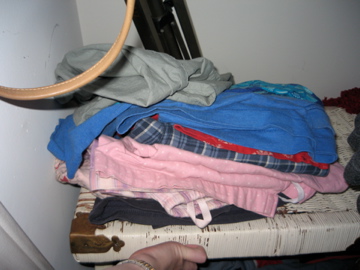
These are my pre-TME clothes.

I have no idea just how much they've all cost me, but I'm still in the process of clearing out the clothes I won't be wearing. I'll post pics again once I'm done with the clearing. (Turns out that when one is in grad school, one's time and energy are perpetually depleted. ?!?!) Every time I do laundry I think, "Where the hell am I going to put all this crap? I have got to give away some of this." But then I try, and I can't seem to force myself to. And so, I wear a third of what I have, and the rest is stuffed into someplace to take up space and fill one more box when I have to move. 
My closet #1

Same closet, different angle

All these drawers are packed. Note the willy-nilly stuff on top.

Jammies.

More jammies. (I love jammies.)

Shoes.
Laundry, not included in previous shots.